
Welcome to Pinghu Zhanpeng Hot Melt Adhesive Web & Film Co., Ltd. Enterprise Official Website.
Hot melt bonding solution provider
+86-573-85032008


Content
Elastic non-woven fabric is a specialized engineered textile that deviates from traditional rigid non-wovens by incorporating high-performance elastomers. Unlike standard polypropylene webs that provide structure but lack "give," elastic non-wovens are manufactured through a combination of melt-blown or spunbond processes using thermoplastic polyurethanes (TPU) or styrenic block copolymers (SBC). This unique molecular architecture allows the material to undergo significant deformation under stress and return to its original shape once the tension is released. The result is a fabric that offers the breathability and cost-effectiveness of traditional non-wovens with the dynamic flexibility required for high-motion applications.
The production of these fabrics often involves "composite" layering, where elastic filaments are sandwiched between layers of soft, skin-friendly fibers. This prevents the rubbery feel of pure elastomers from touching the skin while maintaining the material's structural integrity. By adjusting the ratio of elastic polymers to base fibers, manufacturers can fine-tune the modulus of elasticity, ensuring the fabric is neither too restrictive nor too loose for its intended purpose.
When evaluating elastic non-woven materials, engineers and product designers focus on recovery rates and tensile strength. A high-quality elastic non-woven should exhibit a recovery rate of over 80% after being stretched to its limit. This ensures that products like diaper waistbands or face mask ear loops do not become "baggy" or lose their functional fit over time. Below is a comparison of typical properties found in standard vs. elastic non-woven variants:
| Property | Standard Spunbond | Elastic Non-Woven |
| Elongation Range | 10% - 30% | 100% - 400% |
| Recovery Ability | Negligible | Excellent (High Snap-back) |
| Breathability | High | High to Moderate |
| Softness Hand-feel | Paper-like to Soft | Cloth-like / Silky |
In the medical sector, elastic non-wovens are indispensable for creating ergonomic surgical gowns, compression bandages, and wound dressings. The fabric's ability to conform to the irregular shapes of the human body (such as elbows and knees) without restricting blood flow makes it superior to traditional adhesive tapes. Furthermore, its porous nature allows for moisture vapor transmission, reducing the risk of skin maceration during long-term wear.
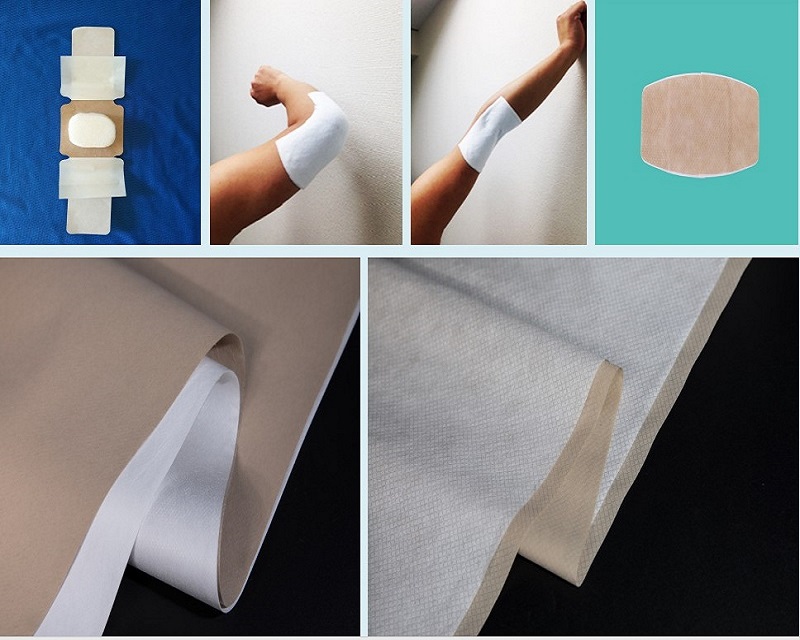
The hygiene industry is perhaps the largest consumer of elastic non-woven materials. They are used extensively in the following components:
Transitioning from mechanical elastic assemblies (like spandex threads glued between sheets) to integrated elastic non-woven fabrics offers several manufacturing advantages. First, it simplifies the supply chain by reducing the number of raw materials needed on the production line. Second, it eliminates the need for complex adhesive application systems, which often lead to machine downtime due to "glue bleed" or buildup.
From a consumer perspective, these fabrics provide a more uniform distribution of pressure. Traditional elastic strands can create "red marks" on the skin due to concentrated tension points. In contrast, elastic non-woven fabrics distribute the tension across the entire surface area of the material, significantly enhancing the user's comfort and the product's aesthetic appeal.
The next frontier for elastic non-woven fabric is environmental sustainability. Traditionally, elastomers are petroleum-based and difficult to recycle. However, recent innovations are introducing bio-based TPU and compostable elastic resins derived from renewable sources. As global regulations tighten around single-use plastics, the development of a fully biodegradable elastic non-woven will be the "holy grail" for the hygiene and medical industries, combining high-performance stretch with a circular lifecycle.







 浙公网安备 33048202000557号